
Artificial Flavoring
Artificial flavoring is a label term for ingredients used to give food a taste or aroma. It covers many different chemicals and blends. The term alone does not tell you which substances are present or how much of each was used.
Also known as
artificial flavor · artificial flavors · artificial flavoring · artificial flavour · artificial flavours · artificial flavouring
Why PRūF tracks it
The health effects of an artificial flavor depend on its chemicals and dose; an unnamed blend cannot be assigned a shared cancer or DNA-damage risk from the label alone.
Read the research
Artificial flavoring describes a broad labeling category. Its health effects depend on the actual chemicals, purity and amounts, so there is no single safe-intake limit or shared cancer risk for everything carrying that label. U.S. rules allow collective flavor labeling and require listed synthetic flavoring substances to be used under manufacturing conditions. In 2018, FDA removed six specific synthetic flavoring uses after animal cancer findings triggered a legal prohibition, while judging the intended dietary exposures to pose low risk; styrene was removed separately because that use had been abandoned.
These actions did not prohibit the whole flavor category. Newer EFSA work illustrates why chemical identity matters: acetaldehyde remains under review for possible DNA damage, while other flavoring assessments reach conditional reassurance or request better exposure data. None of those examples proves that a particular unnamed blend contains the substances discussed. California’s school-food law also requires further product definitions; flavoring alone is not a blanket school-food prohibition.
The review considers missing identity and exposure information, without asserting a common toxic effect.
Research reviewed on September 5, 2026 · 9 sources
Matches
1–12 of 848 matches
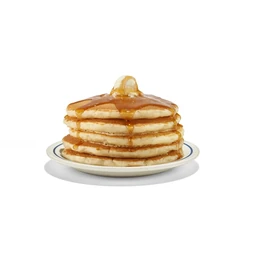 (3) Original Buttermilk PancakesIHOP · Updated September 23, 2026
 (4) Chocolate Chip Pancakes (with Buttermilk)IHOP · Updated September 23, 2026
 (4) Chocolate Chocolate Chip PancakesIHOP · Updated September 23, 2026
 (4) Cinn-a-Stack PancakesIHOP · Updated September 23, 2026
 (4) Cupcake PancakesIHOP · Updated September 23, 2026
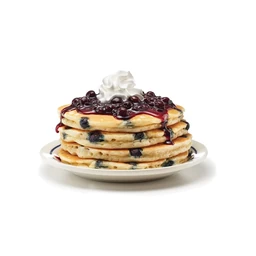 (4) Double Blueberry PancakesIHOP · Updated September 23, 2026
 (4) Mexican Tres Leches PancakesIHOP · Updated September 23, 2026
 (4) New York Cheesecake PancakesIHOP · Updated September 23, 2026
 (4) Oreo Cheesecake PancakesIHOP · Updated September 23, 2026
 (4) Protein Power PancakesIHOP · Updated September 23, 2026
 (4) Pumpkin Spice PancakesIHOP · Updated September 23, 2026
 (4) Strawberry Banana PancakesIHOP · Updated September 23, 2026
Research sources
The published research used in the PRūF app.
- 21 CFR 101.22 — Foods; labeling of spices, flavorings, colorings and chemical preservatives
FDA / eCFR · Current through 2026-09-03 · Accessed 2026-09-05
- 21 CFR 172.515 — Synthetic flavoring substances and adjuvants
FDA / eCFR · Current through 2026-09-03 · Accessed 2026-09-05
- FDA Removes 7 Synthetic Flavoring Substances from Food Additives List
FDA · 2018-10-05 · Accessed 2026-09-05
- Food Additive Regulations; Synthetic Flavoring Agents and Adjuvants
FDA / Federal Register · 2018-10-09 · Accessed 2026-09-05
- Flavourings
EFSA · Accessed 2026-09-05
- Call for data relevant to the genotoxicity assessment of the flavouring substance acetaldehyde [FL No. 05.001]
EFSA · 2026-06-10 · Accessed 2026-09-05
- Flavouring Group Evaluation 82 Revision 2 (FGE.82Rev2): Consideration of epoxides evaluated by JECFA
EFSA · 2026-04-30 · Accessed 2026-09-05
- Flavouring Group Evaluation 216 Revision 3 (FGE.216Rev3): Consideration of the genotoxic potential of α,β-unsaturated 2-phenyl-2-alkenals from subgroup 3.3 of FGE.19
EFSA · 2026-07-02 · Accessed 2026-09-05
- AB 1264 — Pupil nutrition: restricted school foods and ultraprocessed foods of concern: prohibition
California Legislature · Approved 2025-10-08 · Accessed 2026-09-05
Know your food.
Anywhere.
Explore restaurant ingredients and nutrition in the PRūF iPhone app.