
Sodium erythorbate
Sodium erythorbate is an antioxidant used to help foods keep their color and flavor. It also speeds curing in meat products. Known as E 316, this sodium salt is related to vitamin C, but it serves a different role in food.
Also known as
sodium isoascorbate · sodium D-isoascorbate · erythorbic acid, sodium salt · D-araboascorbic acid monosodium salt · D-erythro-hex-2-enonic acid gamma-lactone monosodium salt · E316 · E 316 · INS 316
Why PRūF tracks it
Recent studies linked estimated sodium erythorbate intake with diabetes, cancer and hypertension, despite shared participants, uncertain causation and reassuring older toxicology, with iron absorption and long-term human effects still requiring study.
Read the research
Sodium erythorbate, also called sodium isoascorbate or E 316, slows oxidation and helps cured meat keep its color. It is distinct from erythorbic acid, E 315, and from vitamin C additives. In pumped bacon, U.S. rules require sodium erythorbate or sodium ascorbate to help reduce nitrosamine formation. EFSA retained a daily intake value of 6 milligrams per kilogram of body weight for erythorbates, with exposure evaluated as erythorbic acid; JECFA considered a numerical limit unnecessary for intended food use.
Older animal cancer studies and EFSA’s genetic-toxicity review were reassuring. Three 2026 analyses of the French NutriNet-Santé cohort nevertheless associated higher estimated E 316 intake with type 2 diabetes, overall and breast cancer, and hypertension. The diabetes finding remained after several checks for other dietary and lifestyle factors. These studies used overlapping participants, so they are not independent confirmations, and they cannot show that erythorbate caused disease.
Lower consumers also had elevated risks, weakening a simple dose-response interpretation. No participant exceeded the erythorbate intake value. Small human studies found increased iron absorption from erythorbic acid, which may matter in iron-overload disorders. The review considers these meaningful but unconfirmed human signals, balanced against reassuring toxicology and continued regulated use.
Research reviewed on September 5, 2026 · 11 sources
Matches
13–24 of 463 matches
 #13 The Original Italian (Mini)Jersey Mike's · Updated September 23, 2026
 #13 The Original Italian (Regular)Jersey Mike's · Updated September 23, 2026
 #13 The Original Italian (Wrap)Jersey Mike's · Updated September 23, 2026
 #2 Bacon, Egg and Cheese (Mini)Jersey Mike's · Updated September 23, 2026
 #2 Bacon, Egg and Cheese (Regular)Jersey Mike's · Updated September 23, 2026
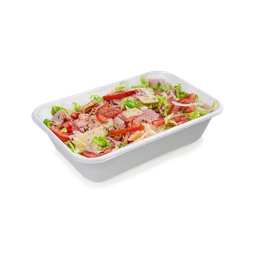 #2 Jersey Shore's Favorite (Bowl)Jersey Mike's · Updated September 23, 2026
 #2 Jersey Shore's Favorite (Giant)Jersey Mike's · Updated September 23, 2026
 #2 Jersey Shore's Favorite (Mini)Jersey Mike's · Updated September 23, 2026
 #2 Jersey Shore's Favorite (Regular)Jersey Mike's · Updated September 23, 2026
 #2 Jersey Shore's Favorite (Wrap)Jersey Mike's · Updated September 23, 2026
 #20 Grilled Pastrami Reuben (Bowl)Jersey Mike's · Updated September 23, 2026
 #20 Grilled Pastrami Reuben (Giant)Jersey Mike's · Updated September 23, 2026
Research sources
The published research used in the PRūF app.
- Scientific Opinion on the re-evaluation of erythorbic acid (E 315) and sodium erythorbate (E 316) as food additives
EFSA ANS Panel · 2016-01-20 · Accessed 2026-09-05
- Erythorbic acid and its sodium salt, WHO Food Additives Series 28
FAO/WHO JECFA · 1990 evaluation; 1991 monograph · Accessed 2026-09-05
- 9 CFR 424.21: Use of food ingredients and sources of radiation
USDA FSIS / eCFR · Current through 2026-09-03 · Accessed 2026-09-05
- 9 CFR 424.22: Certain other permitted uses
USDA FSIS / eCFR · Current through 2026-09-03 · Accessed 2026-09-05
- Intake of food additive preservatives and incidence of cancer: results from the NutriNet-Santé prospective cohort
Hasenböhler et al. / BMJ · 2026-01-07 · Accessed 2026-09-05
- Associations between preservative food additives and type 2 diabetes incidence in the NutriNet-Santé prospective cohort
Hasenböhler et al. / Nature Communications · 2026-01-07 · Accessed 2026-09-05
- Preservative food additives, hypertension, and cardiovascular diseases: the NutriNet-Santé study
Hasenböhler et al. / European Heart Journal · 2026-05-20 · Accessed 2026-09-05
- Regulation 1333/2008: E 315 and E 316 permissions
European Union · Consolidated 2026-08-18 · Accessed 2026-09-05
- List of Permitted Preservatives: sodium erythorbate S.7
Health Canada · Current list dated 2025-10-20 · Accessed 2026-09-05
- Food Standards Code Schedules 15 and 16
Australian Government / FSANZ · Schedule 16 compilation 2025-09-16; Schedule 15 2026-04-30 · Accessed 2026-09-05
- GSFA Online: sodium erythorbate (sodium isoascorbate), INS 316
Codex Alimentarius · Updated through CAC 48 (2025) · Accessed 2026-09-05
Know your food.
Anywhere.
Explore restaurant ingredients and nutrition in the PRūF iPhone app.