
Dipotassium phosphate
Dipotassium phosphate is a soluble salt used to control acidity and keep food mixtures stable. Also called dibasic potassium phosphate or E340(ii), it supplies potassium and inorganic phosphate. Its effects depend on the amount consumed, the overall diet and kidney function.
Also known as
potassium phosphate dibasic · potassium phosphate, dibasic · dipotassium hydrogen phosphate · dipotassium hydrogen orthophosphate · dipotassium monophosphate · dipotassium orthophosphate · dibasic potassium phosphate · dipotassium acid phosphate · secondary potassium phosphate · E 340(ii) · E340(ii) · INS 340(ii) · INS340(ii)
Why PRūF tracks it
Cumulative phosphorus intake and potassium sensitivity warrant attention in people with impaired kidney function, while mixed-additive biomarkers and high-phosphate animal findings leave the clinical effects of ordinary dipotassium phosphate consumption uncertain.
Read the research
Dipotassium phosphate supplies potassium and phosphate, both essential nutrients whose amounts matter. Inorganic phosphate additives can contribute readily available phosphorus beyond that naturally present in foods. EFSA sets a group daily value of 40 mg phosphorus/kg body weight from all dietary sources, and its exposure models exceed that value for some younger groups. The value does not cover moderate-to-severe kidney impairment.
JECFA reassessed the group in 2026 and retained a different value of 70 mg/kg, using a different animal-study derivation. Neither number is a limit specifically for dipotassium phosphate alone. Small feeding studies show changes in mineral regulation when phosphate additives change. A 2025 study found lower FGF23 and parathyroid hormone after reducing additives in adults with kidney disease, but used a fixed diet sequence and did not measure clinical outcomes.
A randomized 2017 study found no significant increase in its primary urine-albumin outcome or FGF23 with higher intake. These findings do not establish that ordinary amounts of this salt cause kidney or cardiovascular disease. A high-phosphate mouse study using this salt found offspring growth and mineral changes, but unmatched potassium and small litter counts limit interpretation; people with kidney disease may also need individualized potassium advice. Organic-label restrictions concern certification and do not constitute a conventional-food safety ban.
Research reviewed on September 5, 2026 · 12 sources
Matches
1–12 of 174 matches
 (4) Mexican Tres Leches PancakesIHOP · Updated September 23, 2026
 2 Scratch Biscuits and 8oz GravyMcDonald's · Updated September 22, 2026
 Bacon Temptation OmeletteIHOP · Updated September 23, 2026
 Beefy 5-Layer BurritoTaco Bell · Updated September 23, 2026
 Beefy Crunch BurritoTaco Bell · Updated September 23, 2026
 Beefy Potato Loaded GrillerTaco Bell · Updated September 23, 2026
 Berry Brown Sugar OatmealJamba · Updated September 23, 2026
 Berry Daydream Refresher - LargeDunkin' · Updated September 22, 2026
 Biscuit and GravyWhataburger · Updated September 23, 2026
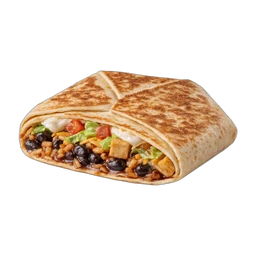 Black Bean Crunchwrap Supreme®Taco Bell · Updated September 23, 2026
 Black Bean Crunchwrap Supreme® (V)Taco Bell · Updated September 23, 2026
 Black Bean Grilled Cheese BurritoTaco Bell · Updated September 23, 2026
Research sources
The published research used in the PRūF app.
- Re-evaluation of inorganic phosphate food additives
EFSA · 2019-06-12 · Accessed 2026-09-05
- Secondary potassium phosphate: 102nd meeting evaluation
WHO/JECFA · 2026; summary issued 2026-07-07 · Accessed 2026-09-05
- Lowering phosphorus additive intake in adults with and without CKD
Study authors · 2025-05-13 · Accessed 2026-09-05
- Phosphorus additives and albuminuria: randomized crossover trial
Study authors · 2017 issue; 2016 online · Accessed 2026-09-05
- Kidney Health Guidance on Potassium and Phosphorus Food Additives
American Society of Nephrology · 2025-09-18 · Accessed 2026-09-05
- 21 CFR 182.6285 Dipotassium phosphate
FDA/eCFR · Displayed current through 2026-08-13 · Accessed 2026-09-05
- E340(ii) dipotassium phosphate specifications
European Union · Consolidated 2026-08-18 · Accessed 2026-09-05
- 7 CFR 205.605 permitted nonagricultural substances
USDA/eCFR · Current through 2026-09-03 · Accessed 2026-09-05
- Food Additives Re-evaluation and Follow-up working group minutes
EFSA · Page update 2026-07-13; relevant meeting June 3–4, 2026 · Accessed 2026-09-05
- P1066 young-child formula review, safety and food technology
FSANZ · 2026-05-26 · Accessed 2026-09-05
- Provisional toxicity values for sodium and potassium salts of inorganic phosphates
US EPA · 2022 · Accessed 2026-09-05
- Maternal high phosphate intake and offspring phosphate metabolism
Study authors · 2025 · Accessed 2026-09-05
Know your food.
Anywhere.
Explore restaurant ingredients and nutrition in the PRūF iPhone app.